
There’s no doubt that the cost of health care and prescription medication continues to be a challenge for many in South Texas and the Hill Country. For those at or near the poverty line, it can sometimes mean choosing between buying food and buying vital medications.
The Hill Country Mission for Health, based in Boerne, is a medical ministry providing charitable primary healthcare for eligible low-income, uninsured or underinsured adults in Kendall County and the Boerne Independent School District, which includes parts of Bexar and Comal counties. The nonprofit is using funds from a Support Grant received from Impact San Antonio last year to help create an onsite pharmacy.
The clinic treats and counsels about 10-18 patients per day from 18 to 64 years old on a sliding payment scale — becoming, in essence, a hub for community health.
Executive Director Connie Padgett, nurse Mary Cortez and nurse practitioner Sarah Martinez are using the $11,000 grant to transform an office into a full-fledged pharmacy and to purchase the key medications their patients need, such as Rybelsus, a new drug designed to improve blood sugar in adults with type 2 diabetes.
“We are about one-fourth of the way through stocking the pharmacy,” Ms. Padgett said. “We were also able to pre-purchase flu vaccines, as it is a requirement to order them in advance.
“Funding from Impact SA has paid for all medications and shots that have not been donated by humanitarian organizations. Additionally, we have been able to purchase pharmacy equipment, supplies, and some furniture necessary to properly operate the pharmacy and dispense medication.”
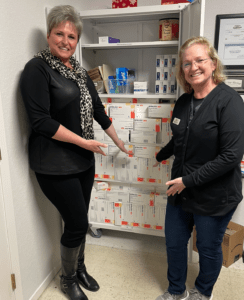 While most of the medications are donated, more specialized medications are purchased through a local collaborative pharmacy partner using the funding from Impact SA, Ms. Padgett added.
While the clinic sees patients with a variety of medical conditions, 70 percent of them have diabetes, and another 20 percent have prediabetes.
“Diabetes is the most prevalent illness we see here at the clinic,” Ms. Cortez said. “The ability for us to keep plenty of diabetes medications on hand, along with other much-needed medications for high blood pressure, high cholesterol, asthma — it’s so important in our ability to take care of those who need us most.”
The clinic is a boon for clients who meet income requirements because “we don’t take any insurance or do any billing, so there is no co-pay for anyone,” Ms. Padgett said. “As long as we have the prescribed medication in stock at the pharmacy, the patient will not be charged for it. If we do not, then we either purchase it for them or, worst case, they go to their preferred pharmacy outside of the clinic.”
The eight paid staff members include nurses, a phlebotomist, administrative employees and a translator because many patients are primarily Spanish speakers. In addition, there are several volunteer positions in nursing, orthopedics and dermatology.
The Impact SA funding means a great deal to the clinic and its clients, Ms. Padgett said.
“Funding from Impact SA has allowed us to pay for medications that are too expensive for the patient and that provided the patient with immediate symptom relief,” she said. “Our goal is to provide the very best health care that we can for them, and that includes relieving them of the kinds of decisions” between food and medications.
Fabiola, a patient at the clinic, is grateful for their services.
“I arrived with my A1C very high without knowing I had diabetes,” she said. “They taught me how to control my diabetes and lower my blood sugar. I would recommend this clinic to others who are in the same situation.”
(830) 249-0130